Come, Pray With Us

I have ascended to the highest in me, and look! The Lord is towering above that. In my curiosity I have descended to explore my lowest depths, yet I found God even deeper. If I looked outside myself, I saw God stretching beyond the furthest I could see; and if I looked within, God was yet further within. Then I knew the truth of what I had read, “In God we live and move and have our being.”

—Bernard of Clairvaux, Cistercian, 12th Century

Cathedral a contemplative film by Fr. Lawrence Morey, OCSO, Gethsemani Abbey.

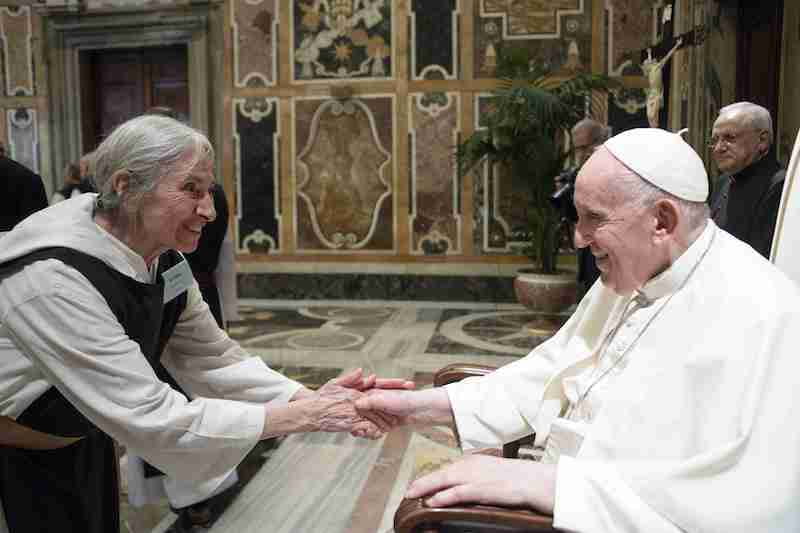
Sister Kathy with Pope
Sr. Kathy greets Pope Francis at OCSO Papal audience, September 2022

Are you a young woman considering your life’s vocation?

Join the Sisters of Redwoods Abbey for Discernment Retreats

Announcements
This Sunday's Mass is open to the public. We'll see you there!

Featured News

February 2, 2026

Sr. Veronique Geeroms was born in Ninove, Belgium part of the Low Countries, the land of mystics. And she was a ‘mystic’ of the ordinary daily monastic life. She comes from a loving and united family whom she keeps alive in her heart. Faith shaped her life at a young [...]

Sr. Veronique Geeroms was born in Ninove, Belgium part of the Low Countries, the land of mystics. And she was a ‘mystic’ of the ordinary daily monastic life. She comes from a loving and united family whom she keeps alive in her heart. Faith shaped her life at a young age where she was one of the leaders of her local ‘Catholic Worker Group’. There her heart was formed to serve the ‘other’ and her outreach to the poor never left her. She entered Our Lady of Nazareth in 1960. Soon after her temporary profession she was sent on the foundation of Our Lady of the Redwoods where she professed her solemn vows in 1966. Sr. Veronique was a pillar of Redwoods and a beloved soul friend to so many guests. Her monastic life was the fertile soil which continued to expand the horizon of her life. Always the ‘other’ was first. She served as guest sister for over forty years, was Prioress and was responsible for the kitchen. Wisdom flowed through her like water flowing through a vibrant stream. She was not aware of the depth of her wisdom, her humility so apparent in who she was. Quick to ask forgiveness from anyone she hurt, always ready to change and grow even in her older age. It goes without saying that our community and guests will miss her greatly. Our solace is that we have her prayer as she rests now in the sacred heart of Christ, the One who was always the center of her life.

Abbey of Our Lady of the Redwoods

18104 Briceland Thorn Road

Whitethorn CA 95589

USA

Insights

March 10, 2026

FIRST SUNDAY OF LENT-A (Gen 2:7-9, 3:1-7a; Rom 5:12-19; Mt 4:1-11) 26 February 2023 Redwoods From early on in the Gospel of Matthew and all the way to Golgotha, we see plainly that Christ did not come into this world to tread the broad and easy way. On the contrary, [...]

FIRST SUNDAY OF LENT-A

(Gen 2:7-9, 3:1-7a; Rom 5:12-19; Mt 4:1-11)

26 February 2023

Redwoods


From early on in the Gospel of Matthew and all the way to Golgotha, we see plainly that Christ did not come into this world to tread the broad and easy way. On the contrary, under the impulse of the Holy Spirit he goes directly to the place where divine battles are fought: that is, to the human heart, symbolized in our readings by two cosmic realities: the depths of the Jordan’s waters, where demonic monsters were thought to lurk, and the desert, where only the saint or the demon can survive. If Satan is the lying anti-hero of appearances—the lord of chaos who at every step is plotting the disruption of the divine order—Christ is the healing God-sent Hero who comes to confront Satan’s logic with clear-headed humility. In this forbidding wilderness, two diametrically opposed solutions to our human plight are at loggerheads: on the one hand, capitulation to the alluring comforts of Satanic suggestions; on the other, surrender to the mercy of God’s providence. Either option requires listening and yielding to a voice outside ourselves. To which voice will I yield?

The desert is the place of utter poverty and, therefore, an invitation to heroic trust in God. When we experience our own barrenness, when we are most in need, then it is that the decisive crises arise within me. Will I accept quick fixes and adore their cunning purveyor, thus betraying my deepest nature and vocation as a person begotten of God? Or will I wait in silence and privation, fasting from all the easy solutions the world has to offer, for the perfect length of God’s pleasure, represented by the forty days and nights that recapitulate Israel’s historical wandering in the desert?

Matthew’s gospel today portrays Jesus’ victory over Satanic temptation as occurring at the end of a 40-day period of fasting and prayer, that is, at a moment when naturally speaking the human Jesus is at his weakest and most vulnerable. Make no mistake about it: the temptations he undergoes are genuine temptations. They are not a show of pious make-believe intended merely to teach us a moral lesson in fortitude. Jesus does not experience the seduction of evil superficially, as an attraction to coarse sensual gratification. But, because of the very perfection of his human nature and the sublimity of his divine person, for Jesus temptation cuts deeper into the soul than it does for us: he is tested at the deepest ontological level. Jesus suffers temptation in its pure state, so to speak, as a mighty gravitational pull to disobedience against his Father’s love and the mission the Father has entrusted to him. What is here at stake is not the possibility of Jesus falling into this or that specific sin; what is at stake is nothing less than the unthinkable: infidelity by Jesus to his divine Sonship, the reality that defines the very core of his being.

Jesus replies to Satan’s seductive promptings with three brief passages from Scripture. Throughout the narrative, Jesus utters no original word of his own as a private individual. He, the Word Incarnate, humbly limits himself to citing Scripture, not argumentatively but with sober succinctness. These three brief scriptural words, which had always belonged to him as the one divine Word, are well-aimed arrows that nullify the Devil’s deceitful way of quoting the Bible. Indeed, Jesus here shows us how only total obedience to God, total internal identification with his Word, can transform mere freedom of choice into perfect freedom of heart and soul.  We are most fully and gloriously ourselves only when God’s Word pervades our whole being, when our whole person is in harmony with God’s goodness and will.  

In today’s encounter between Jesus’ fidelity and Satan’s rebelliousness, the Adversary, for all his angelic intelligence, does not understand the divine logic whereby obedient weakness is transmuted into spiritual power by the alchemy of the Father’s delight in the Son’s fidelity. Only faith can understand this, because only faith can understand the paradoxes of divine love. Satan juggles rationality and irony masterfully, but he is woefully ignorant of the readiness of God’s love to embrace weakness for the sake of his beloved daughters and sons. When Satan gets his sharp teeth into Jesus’ flesh, his fangs crumble like sandstone grinding against steel. Sly, slithering, primal Temptation then becomes perpetual Overthrow. Satan thinks he is testing the weakness of a generic holy man; yet all the while the Wisdom of God is exposing, for all to see, the ultimate impotence of the Deceiver in the face of obedient fidelity and love.

The following words conclude today’s episode in the desert: And behold angels approached [Jesus] and served him. I suggest that in these seven final words we have nothing less than the life-giving fulfillment by the Father of the same three offers Satan has just made to Jesus, but in a perverse and odious way. As gruesome temptation leaves our Lord, serene fulfillment approaches. Instead of Jesus eating the bread Satan tempted him to create out of stones, angels now wait on him as at the heavenly banquet. Instead of casting himself down from the temple parapet, so as to coerce the Father to send protecting angels to prove his love for him, now the Father, unbidden, sends a host of angels to take up, in an earthly setting, their jubilant task of waiting upon Jesus as eternal King of heaven. This divine liturgy, that shows us angels adoring the Word Incarnate, occurs in a radical solitude that extends to earth the pure exchange of love that is the very substance of eternal Trinitarian life.

Along with Jesus, and by the power of his fidelity to the Father, the whole Kingdom of heaven comes to earth. Because the Incarnate Word plainly refuses obeisance to anyone but the Father who utters him incessantly, Jesus himself receives the worshipful heavenly service that Satan had tried to wrest for himself from him, the humble Son. And we ourselves experience God’s marvelous generosity with us when, after we have struggled to serve only the Lord steadfastly come hell or high water, he then overwhelms us with the very things we thought we had renounced forever, only now raised to an infinitely higher potency of truth, durability, and delight. In a small, intimate way we experience Paradise restored!

Let us, then, embrace the freedom given us today by the power of the words of this Gospel and by the grace of this Holy Eucharist we celebrate. Let us choose with a joyful heart to follow Christ more intimately step by step wherever he may lead us during this particular Lententide. Together with him and side by side with one another, we are in the best of company.

Fr. Simeon Leiva-Merikakis, OCSO

NO ONE BUT JESUS ALONE

Second Sunday of Lent-A
(Gen 12:1-4a; 2 Tim 1:8b-10; Mt 17:1-9 )
Redwoods, 1 March 2026

Last Sunday’s Gospel invited us to go with Jesus into a time of trial in the desert, a difficult and drawn-out period that requires perseverance, discernment, and fortitude. And this trial shall continue in underground (but no less real) fashion throughout the forty days of Lent. The Gospel for this Second Sunday of Lent, however, presents us with a counterbalancing though fleeting event that we can miss if we blink too quickly, if we don’t pay attention. The evanescent event of the Lord’s Transfiguration—if we are to profit from it—requires vigilance, clarity and, above all, careful listening. Thanks to the power of the Liturgy to transport us into the Mystery of Christ, the journey of Abram and of Jesus and his disciples today becomes our own Lenten journey of faith.

For Jesus himself, it signifies the passage from the darkness of temptation to the luminous glory of the Father breaking out through his own human body atop Mount Tabor. (When, in a little while, we partake in Holy Communion, let us not forget that we are eating a Body of Glory that communicates Glory.) And this passage of Jesus is, for us, the suggestion of a journey that requires that we trust in the Lord’s promises, as illustrated in the first reading from Genesis with regard to Abram’s call. A journey is here involved in which we are promised “the strength of God’s grace manifested in Christ Jesus”, as Paul announces in the second reading from 2 Timothy: we are called to a crucial journey of growth in faith, love and communion with God and each other. Light here comes from a cloud, and we are told that, in order to eventually see the beauty of God we must first listen, exactly like the blind who, precisely because they are blind, must, for survival, refine their ability to listen to an extraordinary degree.

 This is my beloved Son, in whom I am well pleased. Listen to him! It is as if the heavenly Father were saying to us: ‘Trust me: I should know on whom it is that I choose to lavish all my love. And, if this is the One in whom I am well pleased, you too could not do better than take all your delight in him, in being with him and listening to him. For he alone is reliable, he alone is ever faithful, he alone will fulfill superabundantly every least desire of your heart.’ In this strong and very precise imperative of the Father Listen to him!, and everything it implies, lies the basis for all our essential discernment, that is, for us to make judgments about the reality of each situation and crossroads, and the choices we must make.

In this one man Jesus—both familiar to us from our everyday cohabitation with him and yet utterly startling in this sunburst form—we must come to recognize the Beloved Son of God, sent to us as our sole Way to salvation. For the sake of our own liberation and salvation we must come to see in him the divine Light of Glory, even though his human soul and body may be tested, as with each of us, by all manner of trials and tribulations. We must ultimately come to confess that that condemned Man hanging on a cross on Good Friday is the Savior of the world—which is what makes the day of his horrible execution to be so unfathomably good.

In the distant beginnings of Israel’s history, God had called Abram to leave the land where he lived and set out on an unprecedented journey to a land that was promised to him but that was also, at the outset, totally unknown to him. In parallel fashion, Jesus took three disciples with him up “the high mountain”, the symbolic place of God’s presence and revelation, the place where God had spoken face to face with Moses, but also the place of the sacred tryst with God specifically carved out for us in each of our lives by Jesus himself.

The Gospel text pointedly emphasizes this apartness with Christ as a necessary aspect of discipleship. We read: Jesus took with him Peter and James, and John his brother, and led them up a high mountain by themselves. This took with him, this elevation of the mountain, and this by themselves all designate the decisive importance for the disciples of experiencing the presence and person of Jesus in an aloneness apart from the crowd, a social, psychological and physical isolation, that will prove to be both extremely demanding (because of the renunciations it requires) and extremely rewarding (because of the intimacy with God and enlightenment it bestows).

Both Abram and the disciples had to trust the call and follow it through, not knowing what exactly they were getting into. The one and only certainty the disciples had was that their beloved Lord Jesus would be always with them, and that was enough! They simply trusted his word and guidance.

To go out and face the unknown in an act of trusting a word worthy of trust, and consequently to experience something truly great: for Abraham, this will result in his becoming a great nation and, above all, a blessing that spreads universally. For the disciples, this same going outfrom the known and familiar will result in their beholding the Glory of the eternal Son in this man Jesus whom they are following; it will mean their seeing (emanating from him) the Light which is the transparency of his intimate communion with both the Father and with the Law and the prophets, in the persons of Moses and Elijah. In this manner, God offers his Son to the world as the embodied and unsurpassable Revelation of his love in presence, word and action.

But this movement forward—a movement of departure in the case of Abraham, a movement of ascent in the case of the disciples—is only possible as a response to a promise, made to them in words, that is heard and accepted. It is God who calls Abram to leave his ancestral land, and it is Jesus who leads the three disciples up the mountain, away from everything other than himself, after saying to them: There are some among those standing here who will not taste death before they see the Son of Man coming in his kingdom. This word of Jesus is both a call and a promise, a genuine Word of Good News, because it expresses “the plan and grace of the One who calls”. It is a Word that has existed since all eternity, but which was “revealed to us in the manifestation of our Savior Jesus Christ”, as Paul says today.

Let us note very carefully, at the practical level of life’s ups and downs, that this manifestation to us of the Light of Glory out of God’s eternity occurs not only in the dazzling light of the Transfiguration today (which is, after all, a fleeting event), but also in the crushing darkness of temptations, as we saw last Sunday, a mode of spiritual experience that we know to be much more habitual than any experience of “transfiguration”. We must search for and find our beloved Lord Jesus in the experience of both the light and the darkness: only then are we sure to be searching for and embracing Jesus alone, regardless of the circumstances in which we find ourselves immersed. This “Jesus alone” is the one whom we are called to discern through attentive listening, so that this listening can eventually become seeing, the recognition of the Glory that dwells in God from eternity but which has now been revealed to us in the person and story of the Son. Our most important spiritual task, then, is to develop the habit of sticking to Jesus alone! He is what remains to us with absolute certainty, the one thing we can “grab a holt of” with assurance (as Walker Percy says in his Alabama idiom), after both the harsh desert of temptation and the delightful Tabor of illumination. Yes, Jesus has put himself within our reach in word and sacrament, if we would only reach out and grasp him and not let him go: The disciples fell prostrate and were very much afraid. But Jesus came and touched them, saying: “Rise and do not be afraid.” And when the disciples raised their eyes, they saw no one but Jesus alone.

For the disciples, the word heard and received becomes, on the one hand, a word that directs their gaze toward Jesus alone; and yet, at the same time, it is a word that is transformed into silence, into a total, unfathomable mystery that must be held on to and safeguarded until the moment of its full manifestation in the Resurrection: Tell no one about this vision until the Son of Man has risen from the dead.

Listening in order to see, listening in order to give, listening in order to safeguard and foster: these are the contemplative actions that this Sunday’s readings from God’s revealed Word invite us to perform in order to advance in an ever deeper understanding of God’s gift to us in Christ Jesus. By it God intends us to embody, through Christ and in Christ, a blessing that spreads like a dazzling light over a world so desperately in need of healing divine radiance. Such is the vocation of all Jesus’ disciples, but above all of us Cistercians, his contemplative disciples who are invited to linger and gaze in a more exclusive manner on his beauty and grace every day of our lives, in order then to reflect on to others what of him we have been graciously granted to gaze.

Fr. Simeon Leiva-Merikakis, OCSO

THE ABANDONED JUG

3-A Sunday in Lent

8 March 2026

(Ex 17:3-7; Rom 5:1-2,5-8; Jn 4:5-42)

The wonderful encounter on this Third Sunday of Lent  between the Lord Jesus and the Samaritan woman is surely one of the towering masterpieces of biblical narrative. In the most palpable way possible, it represents nothing less than the face-to-face encounter between the Incarnate Word and sinful humanity, so desperately in need of salvation. Jesus of Nazareth, who walks on the land of Israel with his feet of flesh and bone received from his blessed Mother, and who is himself thirsty and hungry after trudging all these miles from Jerusalem to Sychar—this same Jesus is the eternal Logos in whom and for whom everything was created in the beginning. And this remarkable woman of Samaria embodies the whole of humanity, the men and women of every historical moment and every geographical location. The passionate dialogue that follows between Jesus and the woman impacts us as a summary of the entire history of salvation. Each of us this morning should make the effort of imagination and will of becoming this Samaritan woman so that we, too, can encounter our Lord in the intimacy of our souls, and be saved by the encounter.

Let’s not forget, in the first place, that God’s grace always precedes all our own feelings, thoughts and actions. God’s grace always comes to us, mysteriously, ahead of anything else, while we are still sinners, even before we become aware of our sinful condition and begin to desire forgiveness. This is the central theme that runs through all three readings today. On a certain blessed midday, a poor solitary woman went to Jacob’s well just outside the hamlet of Sychar in Samaria, to draw water; she went at that sun-scorched moment of the day to avoid the glances of others, who scorned her as a great public sinner. At that moment combining stress, shame and exhaustion, she could not have known that at that very same time, in total synchrony with her, the Son of God had already mapped out for himself a route through Samaria, with the intention of making his journey as the weary Savior of the world converge with the journey of the woman, who was so weary from both her sin and her ostracism.

The Samaritan thought she was alone, isolated, abandoned; but that was not, in fact, true. All the while Jesus was already seeking her and loving her, without her knowing it! Her climax of disgrace and drudgery became a kairós of salvation with Jesus’ arrival on the scene. At the well, Jesus breaks into her awful solitude, so that it is two weary people who meet and gradually come to recognize each other through a dialogue of mutual attraction. From all eternity, the divine Word had already been making his way toward this woman, to take her as his mystical bride, as a figure of the Church and of each one of us!

In the Book of Exodus, we see that the people are dying of thirst in the desert, and they mutter against Moses and, through him, against God himself. The Israelites do what is strictly forbidden by the first commandment: they protest against God’s plan and test the Lord. Two weeks ago in the desert, the devil tried to seduce Jesus with the same temptation. Moses cries out today to the Lord because he does not see a way out of the situation. But God carries on with his plan of salvation against all human opposition. He shows his mercy by responding favorably to the murmuring of his people, even though it was a great sin. How can the God of compassion not be magnanimous in the face of people dying of thirst? God answers them by bringing water out of the hardest and driest rock. This detail from Exodus then becomes the main theme of the story of salvation in the Gospel, the theme that contains everything else: namely, that God always brings the water of his life out of the hard rock of our hearts.  

In the second reading, from Romans, St Paul takes up the same theme in different language when he states that God has given us his grace without us deserving it in any way. Christ died for us not because we were “good” or “righteous”. Beyond all our understanding, Christ died for us while we were still sinners, rebels against God. Who would ever conceive of dying for an enemy? Only God! Already at that moment, he called us his “friends”, for whom he wanted to die in order to show us his love. We must believe what is truly incredible: that God imagined us as his friends when we were still his enemies! And yet we become his friends only by virtue of his Son’s death, when God’s love was poured into our hearts from Jesus’ pierced side, when he breathed his last on the cross and, by breathing his last, breathed his Holy Spirit into us.

These first two readings prepare us for Jesus’ extraordinary conversation with the woman at the well. It is the longest, most detailed and most profound dialogue Jesus has with anyone in all four Gospels. And it is not a parable: it is a lived historical narrative. In the course of this riveting dialogue, Jesus does three great things for the woman. First of all, he requests of the woman that she give him a drink. What a paradox! The Incarnate Word feels tired from walking so far in our flesh, and so he asks a fellow human being for help! He does not come to us as a triumphant king riding on a white stallion. Divine omnipotence, because it is all love, approaches us in the form of weakness: here the mystery of the cross already glimmers. When Jesus then says to the woman, Give me a drink, this burning thirst on the part of the Word anticipates the cry of Jesus crucified: I thirst. Yes, Jesus is always thirsty for our faith, for our love. Jacob’s well emerges here as a prefiguration of the Lord’s pierced side, from which blood and water will flow on Good Friday. In Jesus, God gives himself to us as a suffering man. Eternal life, which is his property, comes to us in him hidden deep within his human weakness. Of course, at this point the sinful woman does not understand this gift to her of Jesus’ weakness, but neither does she refuse his request.   

The second great grace Jesus gives the woman is his offer of living water to her, that is, the heavenly gift of eternal life, in ironical exchange for her gift to him of earthly water. The sinner understands this offer least of all! Only the third grace begins to penetrate her heart: it is the confession of sin that Jesus grants the woman from the depths of his own know-ledge of her. Only now is she ready to accept the word of the One she herself proclaims to be a “prophet”. At this stage of the dialogue, the theme becomes the worship of God. After the initial two steps, and still guided by Jesus’ word, the woman now catapults from the depths of sin to the heights of contemplation in her desire to worship in Spirit and Truth. She can now finally welcome Jesus into her heart as he reveals himself to her as the Messiah, the Christ of God. 

At the conclusion of the drama, the water of grace has penetrated to the depths of the sinful soul, has purified her, and has suddenly stimulated her to engage, surprisingly, in a trulyapostolic action among her townspeople. Being now full of Christ’s grace, she casually abandons the jug of her original intention at the well’s edge, since she no longer needs to draw material water by her own effort. The abundant apostolic fruit of proclaiming the Gospel springs spontaneously out of the woman and demonstrates the authenticity of her conversion. Above all else, she now burns to share with the whole world the liberation she has received from Jesus. The woman instantly accepts Jesus’ accusation regarding her five so-called “husbands”; but her acceptance of the accusation and her repentance are almost a minor detail compared to the action of grace, which God has been pouring into her since the beginning of her existence. The grace of God given by Jesus, the grace of God that is Jesus, is the true protagonist of the story, and not the woman. Amazingly transformed from repentant sinner into ardent apostle in the course of one poignant conversation, she now hurries to her fellow citizens to announce the Gospel to them. She wants them, too, to believe and know the joy of salvation given to her by Jesus.

Today, my brothers and sisters, the sacramental mystery of the Sacred Liturgy transforms Whitethorn into Sychar. Our little chapel here, lost in the backwoods of the Lost Coast, becomes the site of our Jacob’s well. We, make no mistake about it, are today that Samaritan woman. Today the long-suffering and weary Jesus has come to seek out and find us in our own weariness and despair, so that we might drink from the abundant water of eternal life from his pierced Heart—the water of his love and compassion, poured into our hearts along with his Body and Blood at this Eucharist. Let us rejoice and be glad!

Fr. Simeon Leiva-Merikakis, OCSO

Monastic Internship Program

Every journey is a liminal space, an in-between time, spanning where I am now and where I hope to end up. While a journey often involves some physical travel, a meaningful journey is accompanied by a displacement of a habitual dispositions and mindsets, while engaging an inner dimension….
Sign Up For Our Email List
Subscribe to Our Newsletter
Monastery Gift Shop
Honey